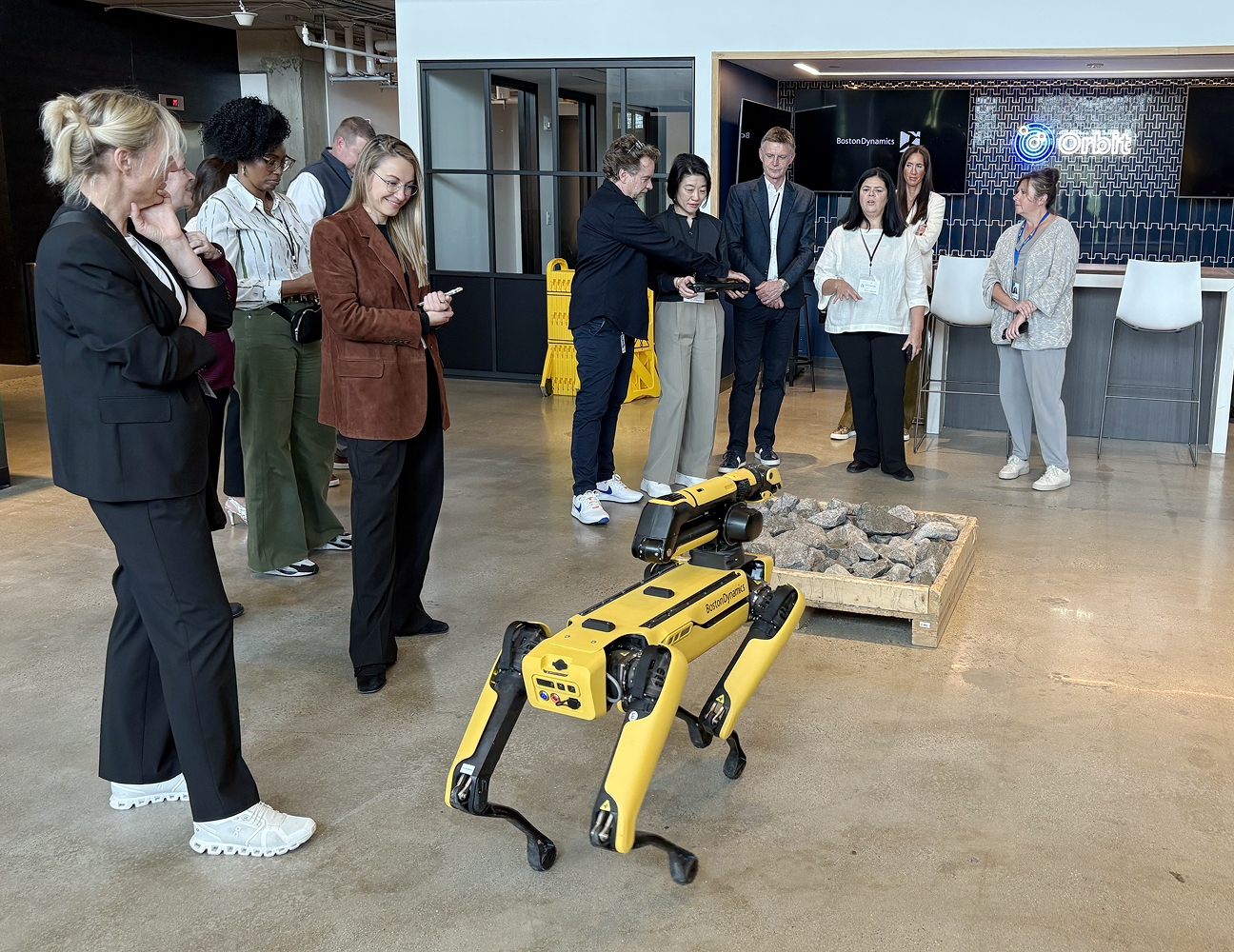
Boston Dynamics executives delivered a compelling vision of the workplace of tomorrow at an M1 meeting hosted by Hyundai Motor Corp CHRO Hae In Kim.
In a test facility down the road from Boston Dynamics’ headquarters, a robotic arm swiftly picks boxes from a pile of cargo and turns to gently place them on a mock conveyor belt. Back in the company’s main building, a four-legged dog-like robot draws gasps as it deftly walks over rocky surfaces, opens a closed door, and retains its balance without falling despite being pushed from the side. A humanoid robot rises from the floor, prompting executives in the room to take a step back, stunned by its life-like presence.
These were just a few of the autonomous robot encounters members of the M1 CHRO Community witnessed in a late May visit to Boston Dynamics, hosted by Hae In Kim, the CHRO of Hyundai Motor Group, which took controlling ownership of the robotics firm four years ago. Executives delivered a compelling vision of the workplace of tomorrow—one where robots work alongside humans not only to cut costs or boost efficiency, but to make work safer, more fulfilling, and more sustainable.
The session, which included demonstrations, a lab tour, and presentations from top executives, centered around how autonomous mobile robots (AMRs) are reshaping industries and how CHROs are essential to managing this transformation. “We’re introducing a new species into the world,” said Boston Dynamics Chief Strategy Officer Marc Theermann.
Addressing Labor Challenges with Intelligent Automation
Theermann pointed to growing labor shortages across industries like logistics, manufacturing, and automotive—a trend exacerbated by an aging workforce and post-pandemic shifts—as a key reason for their development of “autonomous mobile robots.” A major differentiator for the company’s solution, Theermann said, is that Boston Dynamics’ robots don’t require fixed infrastructure or large capital investments and can be deployed in existing facilities, building what he also described as “general purpose” robots.
The vision, he said, is to build “a robot that can go anywhere that a human can go, a robot that can understand the surroundings the way that we do and can then manipulate the environment. We want to get there by the end of this decade.” While the first goal has been reached, and AI is quickly expanding the second, manipulating the environment is still a big challenge.
Real-World ROI: Safer Jobs, Fewer Breakdowns
Boston Dynamics offers three primary autonomous robots:
• Spot, a four-legged autonomous robot used for inspection and data collection;
• Stretch, designed for warehouse and logistics operations; and
• Atlas, a humanoid robot that’s still in development for more complex tasks.
While Atlas is not yet deployed, a couple thousand Spot autonomous robots are already being used around the world, Theermann said, in particular for two use cases. The first is in environments that are dangerous for humans, such as minefields, spaces contaminated by nuclear radiation, or even power plant circuit breakers.
The second is for inspections and predictive maintenance. Robots like Spot are already providing off-hours inspections in factories and warehouses—reading analog gauges, detecting thermal anomalies, and even identifying the presence of rodents.
{{RobotsMeeting_quote}}
Spot has learned to navigate slippery, beer-soaked floors to help one major beverage company sharply reduce equipment downtime, a benefit that far outweighed the labor savings the company expected the robots to bring, Theermann said. “The bigger part of the story is avoiding the equipment breakdown because the robot catches failures before they occur,” he said. “They can fix the manufacturing line on a Sunday and not be in a panic on a Tuesday.”
Stretch, meanwhile, can relieve workers from physically punishing warehouse roles and the repetitive picking and placing of items that worsens employee strain. “From an HR perspective, associates are really smitten with them,” Theermann said. “We thought people would be like, why is this robot doing my job? But nobody wants this job. It's cold in the winter. It’s hot in the summer. It's literally back-breaking work.”
The Human Side of the Robot Revolution
Yet adding robots to the workforce isn’t just a matter of buying and implementing technology. Their success depends heavily on human-centered change management and CHROs who can adeptly manage this transformation.
That means both finding which jobs are best done by humans and which ones by robots—Theermann noted some clients are wanting a robot, for instance, to carry samples between campus buildings rather than having a pricey $350,000-a-year engineer do the carrying.
“It's the humans who are now taking longer to adapt and come up in terms of the culture and the behavioral change and the mindset change that's needed,” said one attendee in response to Boston Dynamics’ presentation.
{{2AIMeeting_furtherreading}}
“We’ll have a workforce that is more fluid and understanding of how to work in partnership with robots,” said another. “I think the two have to kind of grow together.”
To ease that transition, Theermann said Boston Dynamics suggests companies start with deployments of Spot—a dog-like robot that feels more like a “man’s best friend” companion than a threat. “That teaches your HR team, your IT team, your securities team, your workers' council, your unions. It teaches everybody what it means to live with an autonomous mobile robot.”
The company even tracks robot “adoption” through a unique observation: When employees stop taking selfies with the robots, it’s a sign the robots have started to become integrated into the workplace.
Building the Workforce of the Future
To develop talent that can manage robots and work with them, Boston Dynamics has launched both internal and external initiatives. The company advises firms on building robot-ready facilities, with a consulting arm that helps assess readiness and redesign workflows. It has a Human-Robot Interaction department that thinks about the design of how the two will work together. And a rotational training program for young employees is already in place to develop “robot wranglers” who can help work with and around robots. That’s critical, Theermann said, given the high cost and outsized competition for actual robotics engineering talent that many companies struggle to hire.
The discussion moved beyond cost and efficiency to the societal impact of robots in the future.
Boston Dynamics believes the full deployment of humanoid robots is between five and 10 years away. “This is like the Industrial Revolution,” Theermann said. “All of a sudden, we will all have robots at home. Every factory will have autonomous mobile robots. We will see them out in the street picking up garbage. We will see them in our kids’ schools.”
{{WellbeingVermont_event}}
In closing, CHROs debated the evolving identity of their roles—both how HR will be structured, and what it will be called once they are not only managing the work of humans or people, but of AI agents and autonomous robots.
ChatGPT was used to suggest alternative titles for the role, proposing names like “Chief Workforce Integration Officer,” “Chief Human Potential Officer,” and “Chief Work Design Officer.”
Whatever they decide to call it, CHROs who attended the meeting voiced how transformative they see robotics and AI being in HR as it evolves beyond just humans. As one executive put it: “It feels like we went to the future today.”