An emailed survey of M1 members finds many CHROs have expanded portfolios in areas as diverse as communications, real estate, philanthropy, and strategy as CEOs increasingly expect HR executives to be top strategic partners.
CHROs have taken on a dizzying array of responsibilities in recent years, juggling roles that range from pandemic policy adviser and AI strategist to return-to-office broker and social unrest peacemaker.
If it feels like the job is getting bigger—it is.
A new survey of M1 members finds such expanded responsibilities are now part of many CHROs’ official jobs, with 39% of members self-reporting they oversee duties beyond traditional HR. Out of 335 members, 132 reported that functions as diverse as communications, real estate, strategy, legal and even corporate aviation now fall within their remit. Among those who responded, the average number of responsibilities held outside HR was two.
By far, the most frequently mentioned additional responsibility was communications, with 52% of respondents saying they oversee the function. Real estate and facilities were the second most cited, by 25%, and philanthropy and community engagement were named by 24%. Security and risk (17%) and sustainability and ESG (also 17%) rounded out the top five.
What’s driving the expansion of the role are several ongoing trends that highlight both external and strategic realities. A global pandemic, the proliferation of social media and a generation of values-conscious consumers and employees has made earning workers’ trust and communicating employer brand more important for HR than ever. Meanwhile, enhancing employee experience as companies try to draw workers back to the office has tied real estate much closer to HR.
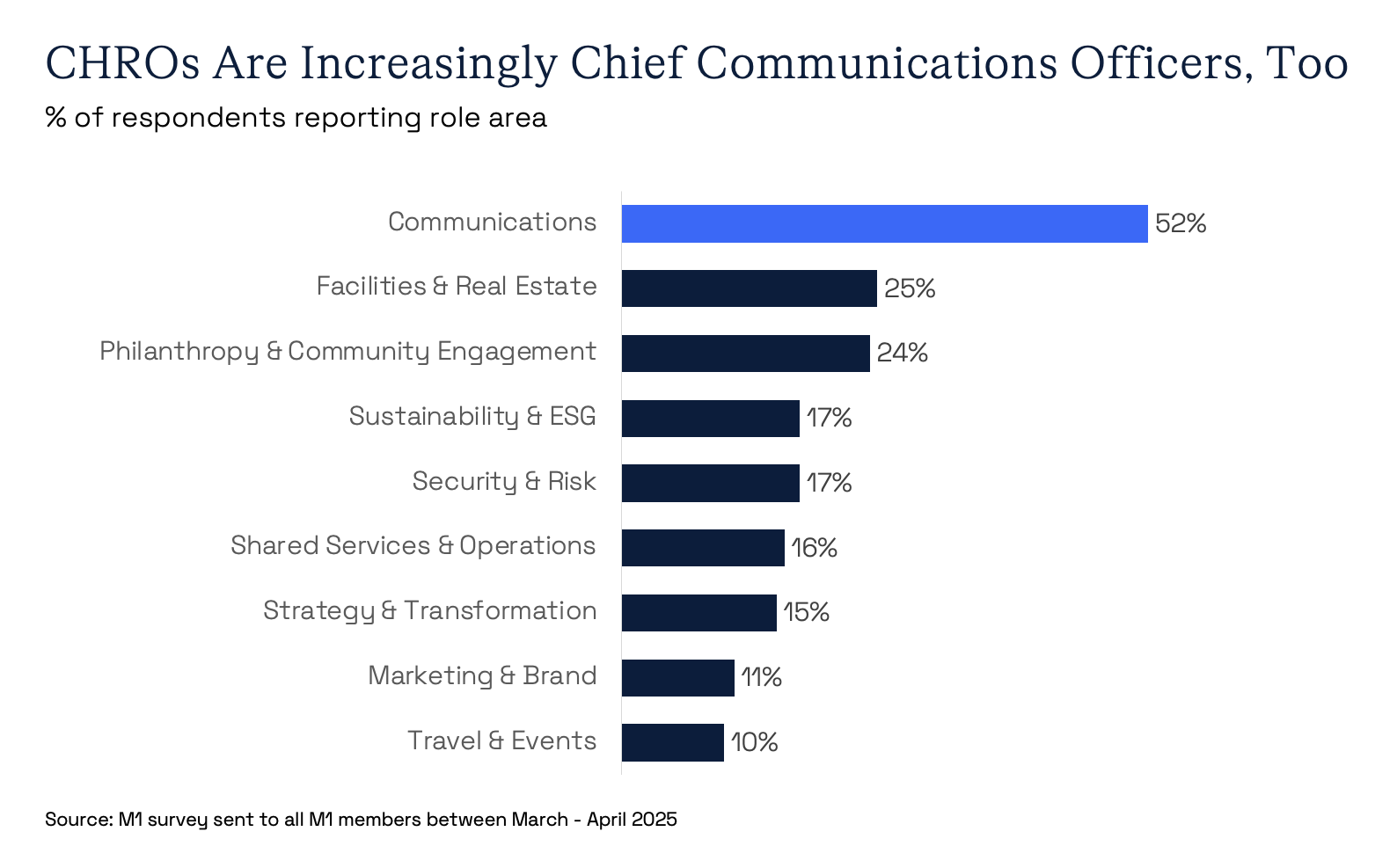
As a result, decoupling either one from the CHRO’s portfolio has become much harder for leaders seeking to drive people strategy, says Dean Carter, a four-time CHRO who leads the CHRO search practice at Modern Executive Solutions. Often the face of the company in employee town halls, CHROs have become responsible for “whether employees trusted you, believed you, thought you are full of it or totally missed it,” Carter says. “The nuance of these communications—every single word—has become so important.”
Meanwhile, artificial intelligence adoption is adding to HR’s broadening remit. At Moderna, the Wall Street Journal reported recently, the company has merged technology and HR into a single function, with Tracey Franklin holding the title Chief People and Digital Technology Officer.
Those with especially broad “mega” portfolios that extend into marketing, strategy or legal tend to have specialized skills or reflect hyper-talented CHROs who add those responsibilities over time, says Scott Macfarlane, a senior partner at Modern who leads the firm’s organizational consulting practice.
He estimates that in some 90% of success profiles for Modern’s CHRO searches or successions, CEOs now expect a much higher level of business acumen and strategic leadership. “It used to be a chief people officer took the business strategy and effectively translated that into the talent strategy,” Macfarlane says. “The step change now is CEOs want an equal partner in the CHRO who is driving the business strategy itself.”
{{CHROSurvey_quote}}
Analog Devices Chief People Officer Mariya Trickett, now in her third CHRO role, sees the evolution of the position as part of a broader shift in how C-suites are structured. Executive teams were initially quite small, then evolved to be highly function-oriented. In a third phase, says Trickett, “C-suites are going to be increasingly more networked, where just [having] the functional expertise is too siloed.” CHROs are particularly well positioned for this, she says, given their visibility of the company, time with the board and role that consistently touches all parts of the business.
Trickett added internal and external communications to her remit a few months after becoming chief people officer in 2022; just over a year ago, she added responsibility for transformation. “The assignment was: How should we envision the next decade of the company?” She works closely with the head of strategy and has since created a business transformation team to help drive the company toward a more commercial orientation—aligning culture, values, incentives and strategic clarity to double down on growth with certain customers.
“I feel super fortunate to have a mandate where I can play so broad,” she says. Adding communications to her role was an important step in her journey to also lead transformation. “The lines between HR topics and communication topics—or how employees think about the company—they're blurring.”
Like Trickett, 24% of CHROs who said they have communications responsibilities own both internal and external comms, but that number is likely even larger: Another 41% listed “communications” as part of their remit, but did not provide further details. (Just over 32% of those who named communications said they lead only internal comms, while just 3% handle external comms only.)
{{01JT6MTH7XXC71Q54NGFAHE4TH}}
Kroger Chief Associate Experience Officer Tim Massa added communications to his HR portfolio more than a decade ago, and government relations in 2020. Having those responsibilities under one umbrella, he says, especially at a company with more than 300 labor contracts, has helped in a range of critical moments, such as when security issues have popped up from time to time at local stores or during recent merger discussions.
While Kroger’s proposed merger with Albertson’s ultimately didn’t get regulatory sign-off, Massa says being the “quarterback” across communications, government affairs, labor relations, and more meant “we had a much stronger, seamless, connected message. I think we had a leg up because we were designed the way we are.” Massa’s broad remit—he also manages corporate aviation, customer care, sustainability, and travel services—fits into a more cross-functional leadership approach at Kroger, he says. “We've really tried to develop a people strategy that leaders bring to life. It’s not HR doing it.”
BMO Financial Group CHRO Mona Malone, who also holds the title Head of People, Culture and Brand, has one of the broadest portfolios among leaders who responded to the survey. In addition to HR, Malone has added marketing, communications, social impact, corporate real estate, and more since becoming CHRO in 2019. Earlier in her career, she held roles as a regional VP of personal banking at BMO and head of marketing at ePost, a BMO and Canada Post joint venture. "Those experiences were all very helpful as I moved in and took on these additional capabilities," she says.
Malone points to BMO’s recent flagship branch launch at Sankofa Square in Toronto as an example of how bringing together HR, corporate real estate, and marketing can help. A large outdoor digital screen on the front of the branch, one of the largest installations in the world of its kind, has tourists flocking to take selfies in front of the bank's brand at one of Canada's busiest pedestrian intersections. Inside the space, retail bankers interact with customers offering advice and digital tools, Malone says. “We are constantly thinking about how employees and customers interact through space, digital technology, and with the brand."
{{LaMoreauxIBM_furtherreading}}
Malone has also found ways to move leaders between the functions she leads to both lean into their strengths and offer development opportunities. Over the last few years, for instance, she’s moved executives from her marketing team to lead talent acquisition. “What they brought was a deep sense of digital marketing, design thinking, data-driven decision making, and deep understanding around experience design—all of which is hugely helpful for talent acquisition.”
One challenge, she says, is “when you have a portfolio of different functions, it's always hard to find that balance of where you go deep and where you stay broad. Effective leaders can do both, but your judgment around when you're doing that and for what is a big part of success.”
The span of all those added responsibilities is reflected in CHROs’ compensation, as CEOs increasingly recognize talent is as much a strategic lever as finance for driving value and transformation. Macfarlane expects to see continued year-over-year growth in total compensation, increasing parity or near-parity between CHRO and general counsel pay and more board willingness to meet long-term incentive buy-out needs of CHRO candidates.
“CHROs never used to be on a proxy statement—ever,” Macfarlane says. “The fact that we have publicly available data on so many chief people officers is itself an acknowledgement the role is demonstrably more important than it was even several years ago.”
{{ParisCHROMeeting}}
Even if companies have grown the portfolios of more CHROs, they often become disaggregated when the executive retires or moves on—and it’s relatively rare that new CHROs are hired into the role with a broad span. Organizations need to be careful about cutting and pasting broad job profiles from one leader to the next, says Modern’s Carter. “Were these roles designed because this is how we want the role to behave and how the organization wants it? Or was it shaped around the personal interests and expertise of the executive?”
Still, it’s clear the trend is toward expanded roles, especially in an era when CEOs and public company boards want CHROs to not just translate strategy but drive it themselves. If historically, the HR function led through expertise—armed with knowledge and deep subject area savvy that propelled them upward for years—now they must lead with communications influence, strategic acumen and cross-functional leadership skills. Says Macfarlane: “Effectively, you’ve got to be a better leader. You can’t rely on just your knowledge and expertise to lead the team anymore.”